
An ode to Android
I can write whatever I want, and you can buy whatever you want, but you should probably skip the iPhone

This post is completely off-topic. But it’s my Substack, so I can write whatever I want!
I recently “upgraded” my phone from Samsung to Apple. I’ve been using my new phone for nearly a month, and reached a surprising conclusion: the conventional wisdom is wrong, and most people, at most budgets, should buy an Android.
Comparison points: my old phones
When I first got a phone in my late teens (I’m old!), I went for a cheap model from BLU, a budget company that still makes unlocked and prepaid phones, usually by rebadging Chinese models. I also used an EE Harrier Mini for a while in the UK. Then I bought myself an LG G5, and, when it broke, a second one. Next I went for an LG G8x, and finally a Samsung Galaxy S21 FE. I got most of them open-box, generally opting for last year’s flagship or almost-flagship models, and never spent more than $300.
Of those phones, the LG G5 was, for its time, unequivocally the best. It had a camera comparable to the Galaxy S21 FE and a screen with a whopping 554 pixels per inch resolution. You cannot buy a single phone today with the same display sharpness. (It did come at the expense of battery life.) The phone was also super-compact and light by modern standards.
The G8x, by contrast, was not very good. The S21 was a good phone but also suffered from weak battery life.
Where iOS wins
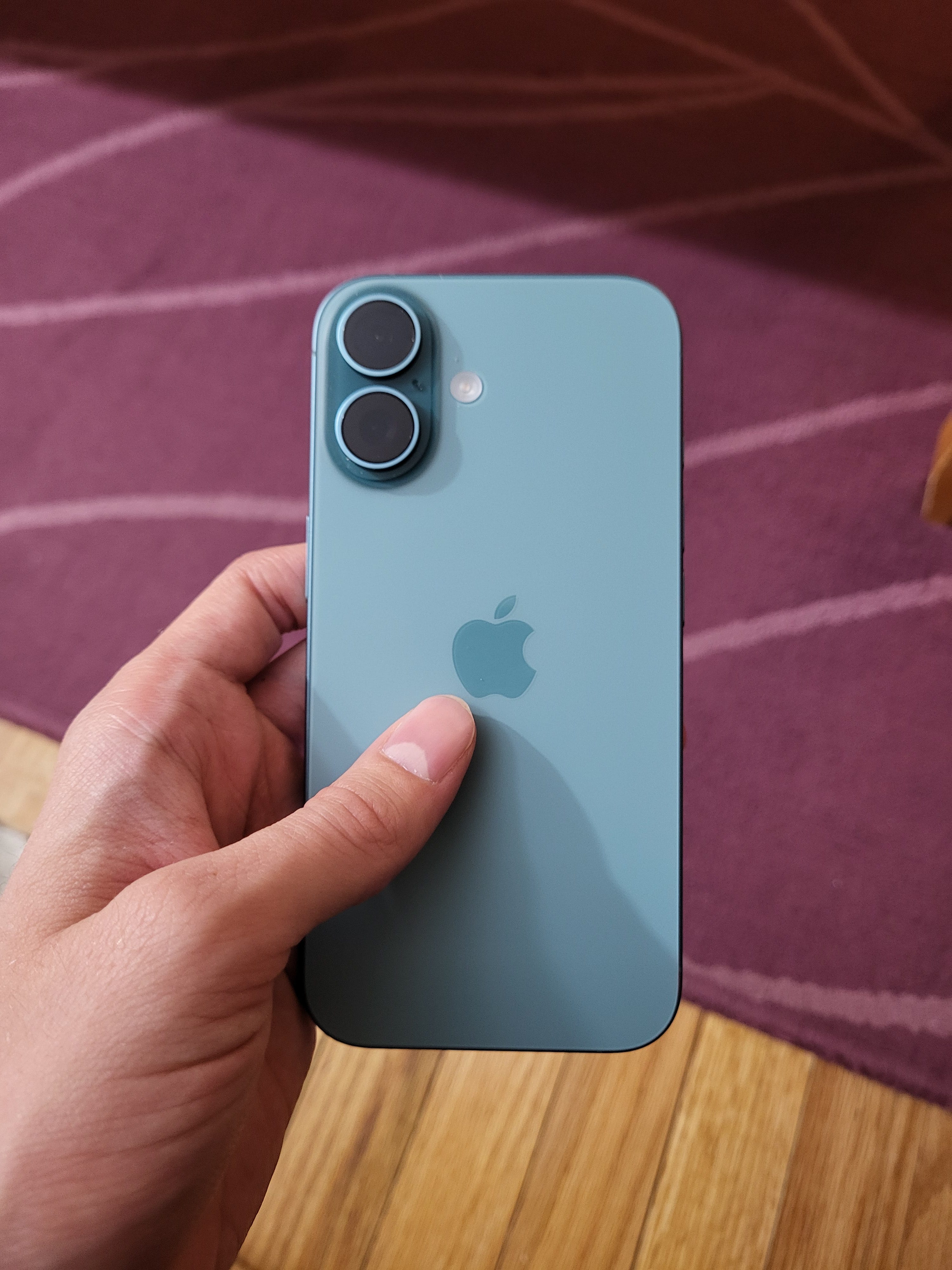
I still hate overspending, so I went with last year’s model, a regular iPhone 16 on sale for Black Friday (but brand new this time). It was $680. Had I stayed with Android, I’d have picked up a Galaxy S25 for the same price. The Google Pixel is also a strong choice, I’m just personally not a fan of the camera on that phone.
My iPhone has a few important strengths:
Battery life. Depending on usage, I’m getting anywhere from 7.5 to 11 hours of screen-on time per full charge (assuming a full 100%-0% discharge, though of course you should never fully charge or discharge). My S21 FE never cleared 4.
Camera hardware. The main sensor is exceptional, with low noise and extremely good resolved detail, even in low light.
Design. The phone is compact by modern standards (about 150 mm tall) and very well-built. Call quality, speaker quality, and microphone quality are also first-rate.
Screen quality. The refresh rate is only 60Hz, which really bothers some people. But refresh rate doesn’t matter. I always turned off the 120Hz option on my S21 FE to save battery life, and you don’t notice it except when scrolling. What does matter is resolution. If you have young eyes like mine, Full HD won’t cut it on a premium phone. On the S21 FE, I could still easily see individual pixels. The iPhone’s 460 ppi resolution is just high enough to avoid that, most of the time. (It’s still not as good as my old LG G5, though.)
I haven’t had to really use FaceTime yet, but by all accounts it beats any alternative.
In these areas, the iPhone easily beats an S25 or Google Pixel.
Where Android wins
Android offers a dramatically better, more polished software experience.
Universal “back” gesture. Swiping “back” always takes you back on Android. On iOS, a swipe backs works for some apps, but otherwise you might need to swipe down or click a “close” button somewhere.
Keyboard. For some bizarre reason, you need two taps to access a period or a comma on iOS. The keyboard isn’t very accurate, either.
No easy settings access. On Android, you can access all settings by swiping down to what Apple calls the “control center.” On Apple, you need to open a separate app. And this is true even for the settings for other apps—camera settings are not in “camera” but in “settings.”
CarPlay stinks compared to Android Auto. In my car, I can’t pan or pinch-to-zoom on maps, which makes navigation distracting and dangerous. (It may work better on some vehicles.) The overall interface isn’t great, either. I can’t judge Siri yet, but by all accounts it’s inferior to Gemini as a voice assistant.
Fewer bugs. The iPhone has weird bugs like inconsistent saturation when apps are in menu view, or shifting screen colors when scrolling through HDR videos. Android has some bugs, but not as many.
Better camera software. Apple reserves ProRaw support for its “Pro” phones. The camera app also includes no manual controls, and I’m not a big fan of Apple’s color processing—it’s more true-to-life than Samsung’s, but Samsung does a much better job capturing the effect of a scene. Basically, you need a third-party app or post-processing to create usable photos, even if the underlying hardware is spectacular. (Apple also leaves out the telephoto lens you’d get on a Galaxy S25, but the main sensor is so good it almost doesn’t matter.)
Clumsy notifications. On Android, you can just pull down any email notification to see the content; you can’t do the same on Apple. It’s also harder to dismiss notifications or see lots of them at once.
Basically, my impressions reverse conventional wisdom: Apple offers great hardware for the price, but the software experience feels amateurish.
So should anybody get an iPhone?
I can think of one reason to go for Apple: the ecosystem. If you already have a Mac, AirPods, an iPad, and an Apple Watch, you might as well complete the interoperability with an iPhone. But I use none of those, other than an iPad. (To be fair, I may switch to Mac next time I buy a new laptop. Windows 11 is laggy, buggy, and hideous, so I plan to run Windows 10 till it literally stops working.)
If you’re a professional photographer with money to burn, you might also consider the iPhone 17 Pro with the extra telephoto lens. You’ll get better video quality than Samsung offers, and you won’t need to deal with the Galaxy S25 Ultra’s massive size (that would be the Android equivalent for top-notch photos).
At full price, Apple new base iPhone 17 also has another great advantage: 256 GB of storage. But you should never pay full price for an Android, and you can easily find an S25 on sale for under $700 (vs. $820 for the iPhone 17).
For most people, then, Android is the better choice. And of course you don’t need to approach iPhone prices to get a strong phone; you can get a Pixel 9a for $350. That’s all the phone most people need. I’m afraid the Apple hype really is mostly hype.